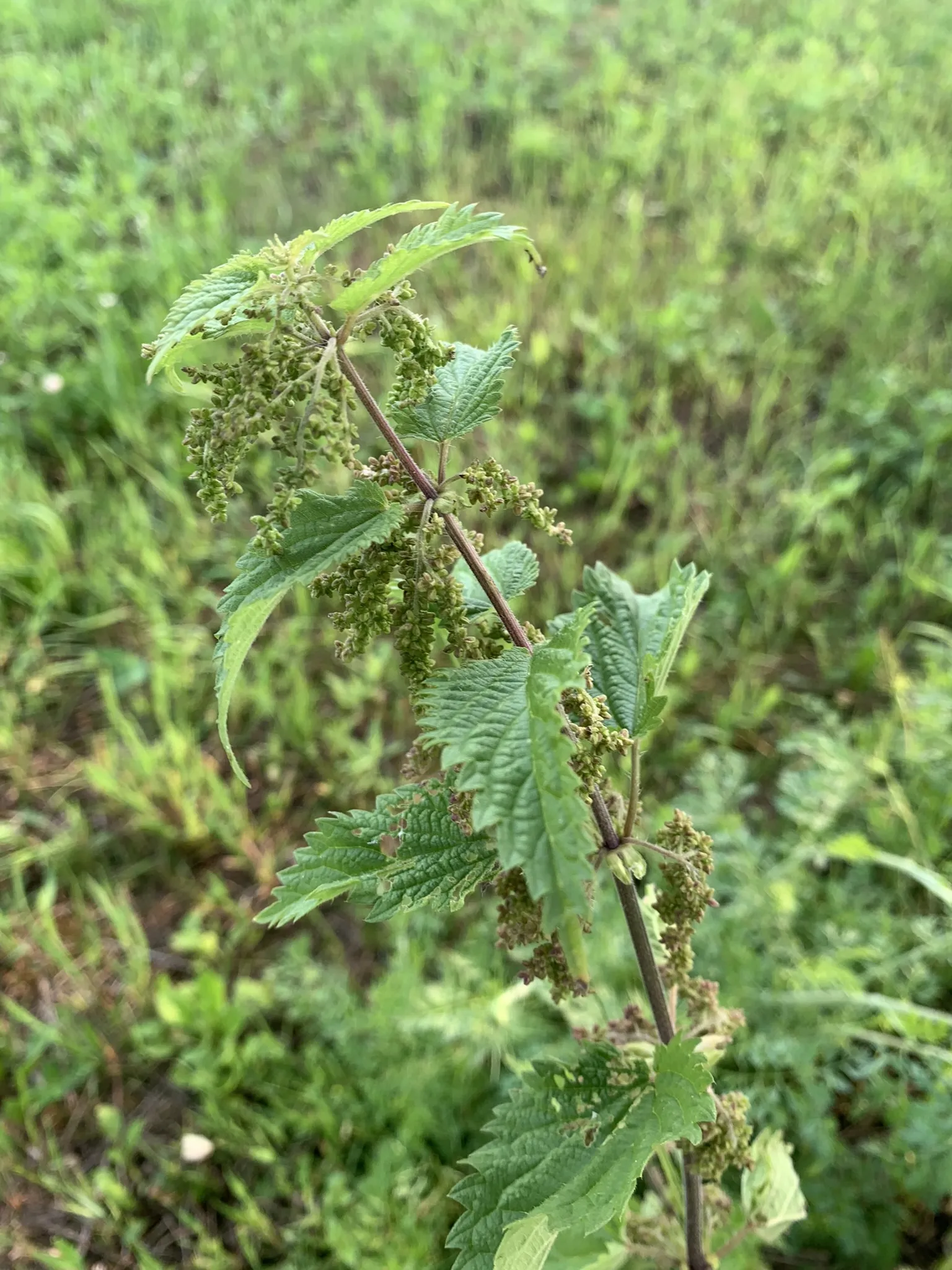
Stinging Nettle
Family: Urticaceae - Genus: Urtica - Species: U. dioica
Other names: Common Nettle, Nettle, Brennessel, Burning Nettle, Hemp Nettle
Quick facts
- Uses
- Edible
- Medicinal
- Tea
- Edible parts
- leaf, seed
- Type
- perennial herb
- Flowers
- Jun–Sep
- Height
- 60–200 cm
- Native to
- Europe, Asia and North Africa
- Habitat
- moist rich soil, stream banks, field edges
Everyone remembers their first nettle sting. But once you know how to handle it, stinging nettle is one of the most useful plants you'll find. It's delicious, very nutritious, and the sting disappears completely once it's cooked or dried.
It grows in big patches in rich, damp soil, often along streams, at field edges and around old farm buildings.
How to spot it
- Stinging hairs cover the leaves and stems. Their glassy tips snap off when touched and inject an irritant.
- Leaves grow in pairs, heart-shaped to long and pointed, with coarse, saw-like teeth.
- Stems are square and grow 60–200 cm tall.
- Flowers are tiny and green, hanging in thin strings from where the leaves meet the stem.
What it's good for
In spring, put on gloves and pick the top four to six leaves from young plants, before they flower. Cook them like spinach, or make nettle soup or pesto. They're full of iron, calcium, vitamins A and C and protein.
Dried nettle makes a mild, grassy tea. Herbalists use it for hay fever, sore joints and as a diuretic, and use the root for prostate problems.
The long fibres in the stems were once spun into thread and woven into cloth.
Don't confuse it with
- Dead-nettles look a little similar but have no stinging hairs and soft, often purple flowers. They're edible too.
- Wood nettle stings as well and is eaten the same way. Its leaves grow one at a time instead of in pairs.
Gallery
Stem with toothed leaves and drooping flower clusters Tall plant with narrow, toothed leaves Dense patch of young leaves Large stand in flower Young plant with toothed leaves Tall stand beside a building
Where it grows
Each hexagon shows how many times Stinging Nettle has been recorded there, from herbarium specimens, surveys and iNaturalist photos. Gaps can mean nobody has looked, not that the plant is absent.