Shepherd's Purse
Family: Brassicaceae - Genus: Capsella - Species: C. bursa-pastoris
Quick facts
- Uses
- Edible
- Medicinal
- Edible parts
- leaf, seed
- Type
- annual herb
- Flowers
- Jan–Dec
- Height
- 10–50 cm
- Native to
- Europe and Asia
- Habitat
- gardens, fields, roadsides
| Month | Observations |
|---|---|
| January | 132 |
| February | 255 |
| March | 427 |
| April | 735 |
| May | 512 |
| June | 156 |
| July | 67 |
| August | 34 |
| September | 45 |
| October | 56 |
| November | 67 |
| December | 97 |
Shepherd's purse is a tiny, unassuming member of the mustard family, and it is everywhere. It turns up in gardens, cracks in the pavement and field edges, and it can flower almost any month the ground isn't frozen.
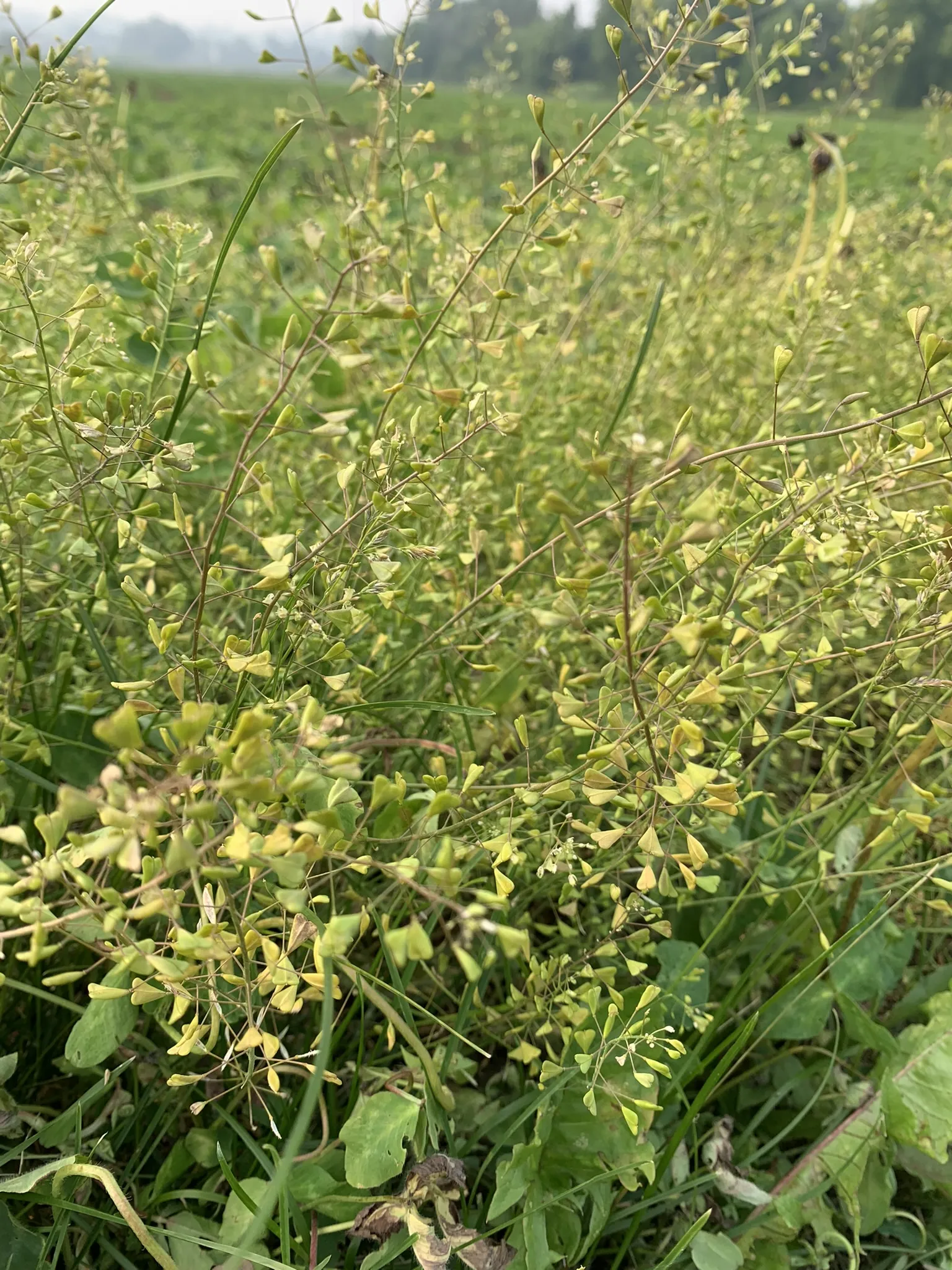
Look at the seed pods and the name makes sense. They're small and heart-shaped, like the leather pouches shepherds once carried on their belts.
How to spot it
- The rosette of leaves at the base is often deeply lobed, a bit like a small dandelion. The shape varies a lot from plant to plant.
- Stem leaves are small and arrow-shaped, and they wrap around the stem.
- Flowers are tiny and white with four petals, clustered at the top of a thin stalk.
- Seed pods are flat triangles or hearts on short stalks all the way up the stem. Once you know them, you'll never miss them.
What it's good for
The young leaves have a peppery, cabbage-like taste and are good raw or cooked. In parts of China it's grown as a vegetable and used in dumplings. The seeds and young pods add a peppery bite too.
Herbalists know it best as a remedy to slow bleeding, both on cuts and for heavy periods. There isn't much research to back that up yet.
Gallery
Plants gone to seed in a field Heart-shaped seed pods along the stems Seed stalks with triangular pods
Where it grows
Each hexagon shows how many times Shepherd's Purse has been recorded there, from herbarium specimens, surveys and iNaturalist photos. Gaps can mean nobody has looked, not that the plant is absent.