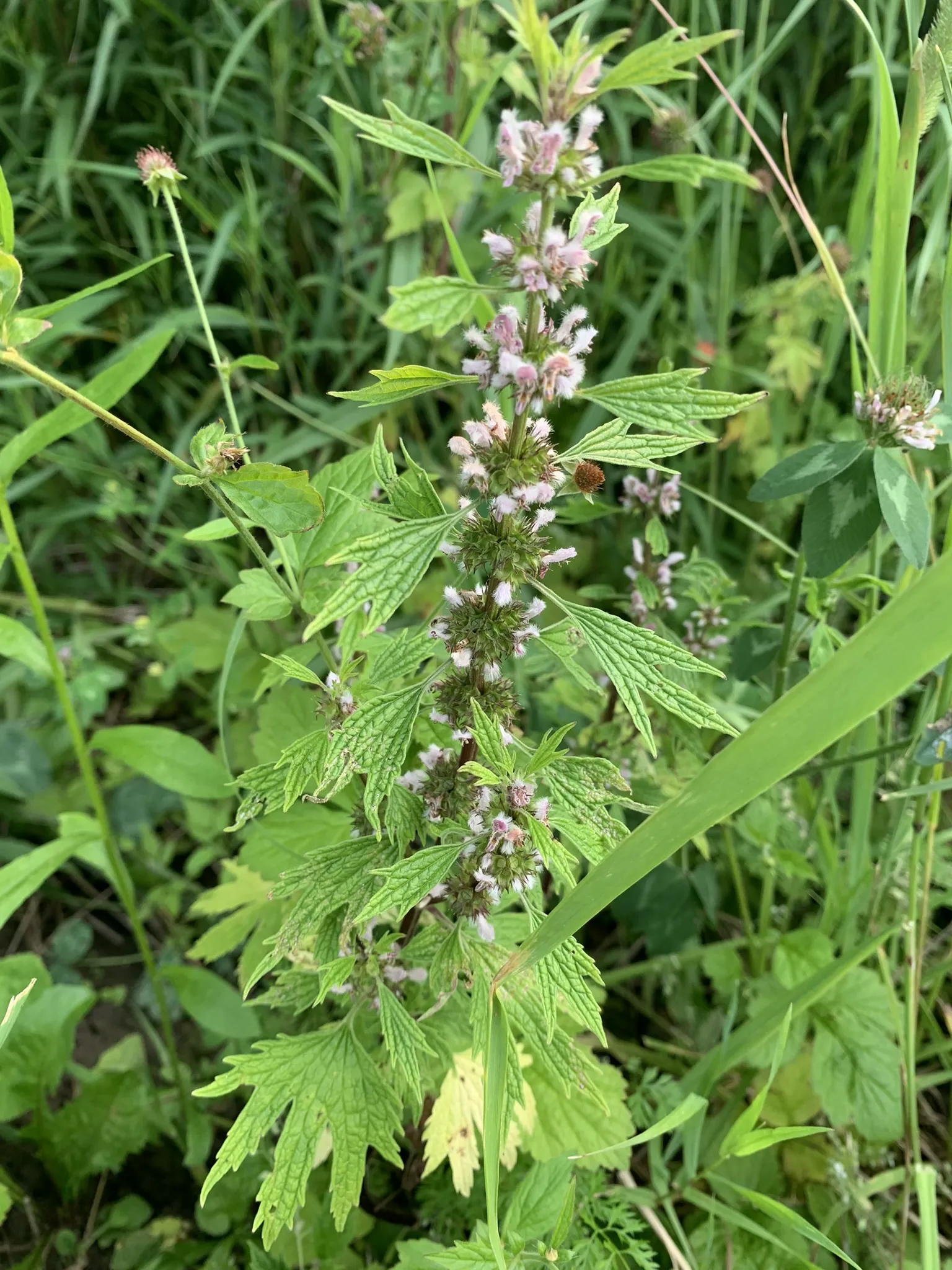
Motherwort
Family: Lamiaceae - Genus: Leonurus - Species: L. cardiaca
Other names: Lion’s Ear, Lion’s Tail, Throwwort
Quick facts
- Uses
- Medicinal
- Tea
- Edible parts
- None
- Type
- perennial herb
- Flowers
- Jun–Aug
- Height
- 60–150 cm
- Native to
- Europe and central Asia
- Habitat
- field edges, waste ground, woodland edges
| Month | Observations |
|---|---|
| January | 0 |
| February | 0 |
| March | 0 |
| April | 1 |
| May | 24 |
| June | 797 |
| July | 522 |
| August | 133 |
| September | 53 |
| October | 23 |
| November | 8 |
| December | 0 |
Motherwort is a tall, rangy member of the mint family that grows along fences, at field edges and in neglected corners of farms. In summer it's covered in little pink flowers and buzzing with bees.
Its Latin name says a lot about its history. Leonurus means "lion's tail", after the shape of its flower spikes, and cardiaca refers to its use as a herb for the heart.
How to spot it
- Lower leaves are deeply cut into three to five pointed lobes, a bit like a hand or a maple leaf. Leaves higher up are narrower, with three points.
- Stems are square, often purplish, and grow 60–150 cm tall.
- Flowers are small, furry and pink to pale purple. They grow in rings around the stem at each pair of upper leaves.
- Seed heads have sharp, spiny tips. Wear gloves if you handle the plant in late summer.
What it's good for
Motherwort has been a herbalist's favourite for centuries. A bitter tea or tincture of the flowering tops is a traditional remedy for anxiety, a racing heart and period pain. As the name suggests, it's especially known as a herb for women's health.
Modern research is limited. The bees, though, have no doubts about it.
Gallery
Flower spike with pink flowers at the leaf joints Dense stand of flowering plants Flower spikes in a dense stand Tall flowering stem Flowering stems at a woodland edge Close-up of pink flowers and lobed leaves Large patch in full bloom Deeply lobed, toothed leaves
Where it grows
Each hexagon shows how many times Motherwort has been recorded there, from herbarium specimens, surveys and iNaturalist photos. Gaps can mean nobody has looked, not that the plant is absent.