Dogwood
Family: Cornaceae - Genus: Cornus - Species: C. florida
Quick facts
- Uses
- Medicinal
- Wildlife
- Edible parts
- None
- Type
- perennial tree
- Flowers
- Mar–May
- Height
- 6–12 m
- Native to
- Eastern North America
- Habitat
- woodland edges, forests
| Month | Observations |
|---|---|
| January | 1 |
| February | 6 |
| March | 662 |
| April | 2330 |
| May | 1073 |
| June | 10 |
| July | 0 |
| August | 1 |
| September | 3 |
| October | 2 |
| November | 2 |
| December | 0 |
Flowering dogwood is one of the loveliest small trees in eastern North America. In early spring, before its leaves open, it's covered in what look like big white flowers. In autumn, the leaves turn deep red and the branches fill with shiny red berries.
It's the state tree of both Virginia and Missouri.
How to spot it
- The "flowers" aren't really flowers. The four white "petals" are bracts. The true flowers are the small greenish-yellow cluster in the middle.
- Leaves are oval and grow in pairs. Their veins curve up towards the tip. Gently pull a leaf in half and fine, stretchy threads will hold the two pieces together.
- Bark on older trees breaks into small square blocks, a bit like alligator skin.
- Berries are bright red and grow in tight clusters in autumn.
- Size is usually 6–12 m, with a wide, flat-topped crown.
What it's good for
Birds love the berries, which are rich in fat, and eat them to fuel up for migration. People don't eat them, because they're bitter.
Indigenous peoples and early settlers made a bark tea to treat fevers, and it was used as a quinine substitute during the American Civil War. The wood is very hard and was used for tool handles and the shuttles on weaving looms.
Other dogwoods
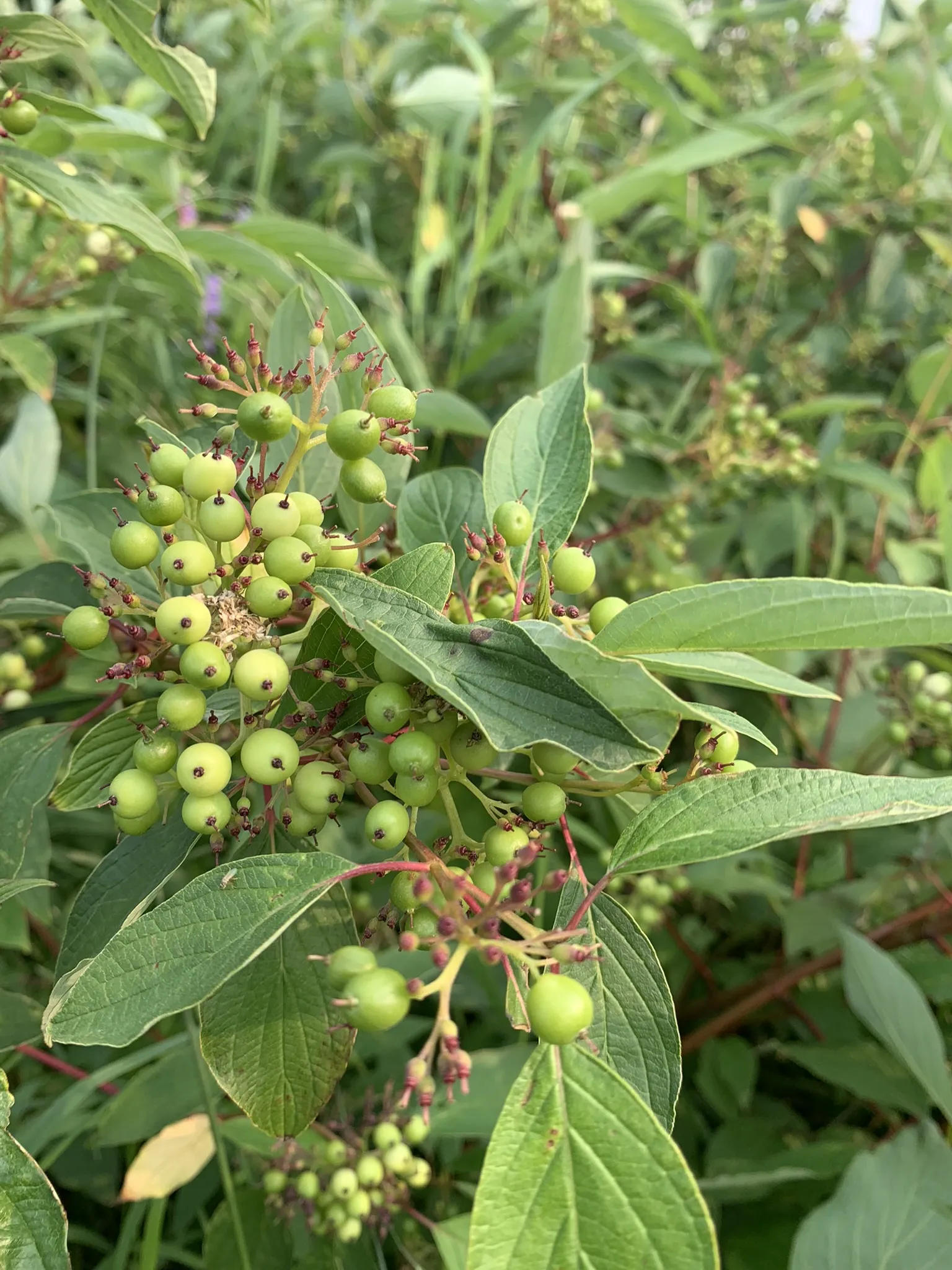
Shrub dogwoods, like red-osier and grey dogwood, are common at field edges. Some of the photos above show one. They have the same curved leaf veins, but they have small flat flower clusters without the big white bracts, and white or blue berries.
Gallery
Clusters of unripe berries and oval leaves Branches with berry clusters and red stalks
Where it grows
Each hexagon shows how many times Dogwood has been recorded there, from herbarium specimens, surveys and iNaturalist photos. Gaps can mean nobody has looked, not that the plant is absent.