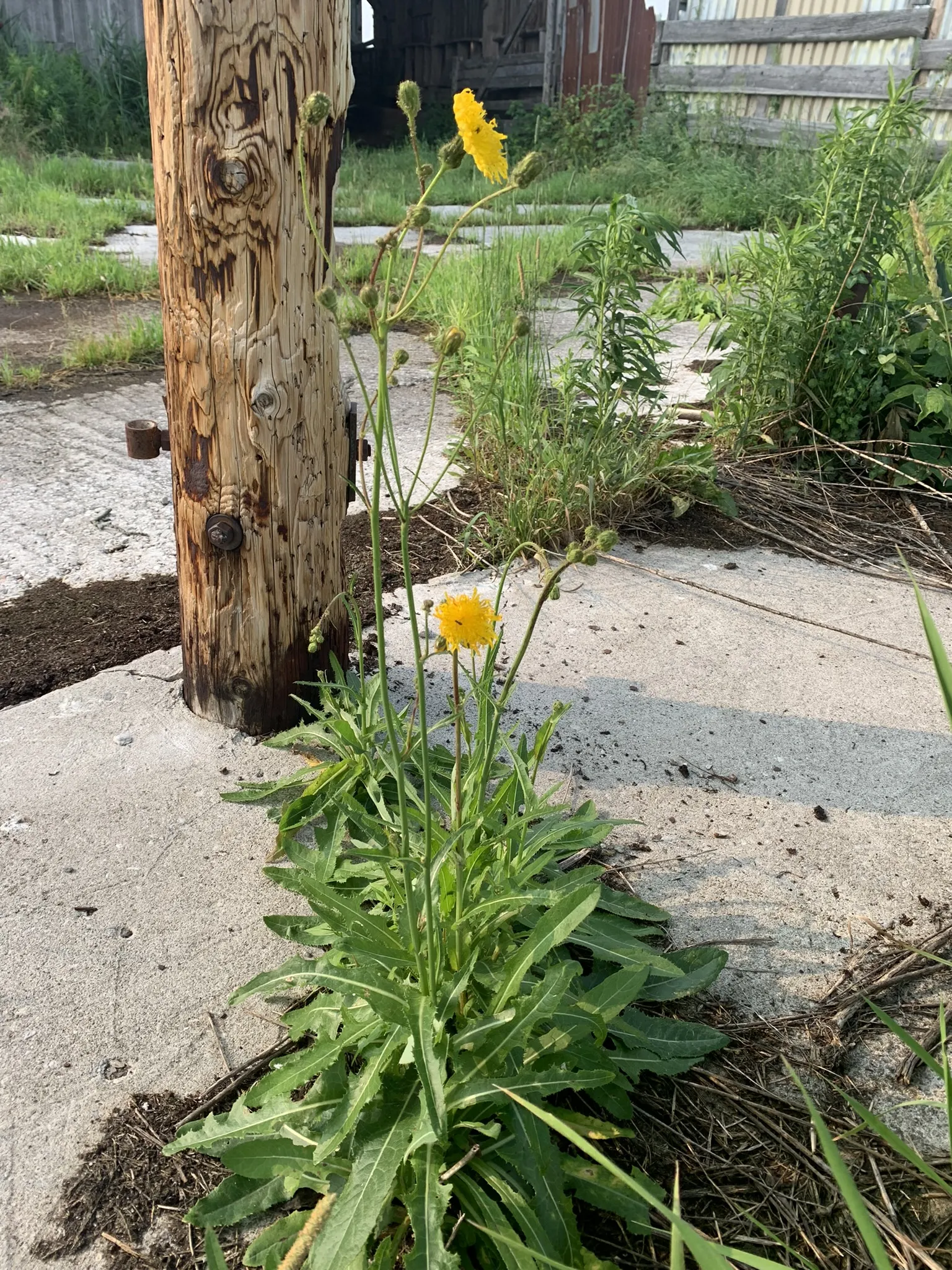
False Dandelion
Family: Asteraceae - Genus: Hypochaeris - Species: H. radicata
Other names: Flatweed, Catsear, Hawkweed
Quick facts
- Uses
- Edible
- Edible parts
- leaf, flower, root
- Type
- perennial herb
- Flowers
- Apr–Nov
- Height
- 20–60 cm
- Native to
- Europe
- Habitat
- lawns, pastures, roadsides
| Month | Observations |
|---|---|
| January | 21 |
| February | 11 |
| March | 17 |
| April | 97 |
| May | 247 |
| June | 319 |
| July | 214 |
| August | 181 |
| September | 197 |
| October | 121 |
| November | 64 |
| December | 17 |
Catsear, also called false dandelion, looks enough like a dandelion that most people never notice the difference. The two are close relatives, and both are edible, so mixing them up isn't a problem in the kitchen.
It loves lawns, pastures and roadsides, and it often keeps flowering long after the dandelions have finished. It will even grow through cracks in concrete.
How to spot it
- Leaves grow in a flat rosette, with shallow, rounded lobes. They're covered in stiff hairs, a bit like a cat's ear.
- Flower stalks are tall, solid and wiry, and they often branch, with a flower at each tip.
- Flowers are yellow and look like small dandelions.
- Seed heads are fluffy white clocks, just like a dandelion's.
What it's good for
Use it the same way as dandelion: leaves in salads or cooked, flowers as a garnish, and the root roasted. The leaves are less bitter than dandelion, but the hairs make them a little rough when raw, so many people prefer them cooked.
Telling it from dandelion
- Leaves: dandelion leaves are smooth; catsear leaves are hairy.
- Stalks: dandelion stalks are hollow and carry one flower each; catsear stalks are solid and often branched, with several flowers.
Gallery
Plant growing through a crack in concrete Yellow flower head on a branched stalk
Where it grows
Each hexagon shows how many times False Dandelion has been recorded there, from herbarium specimens, surveys and iNaturalist photos. Gaps can mean nobody has looked, not that the plant is absent.