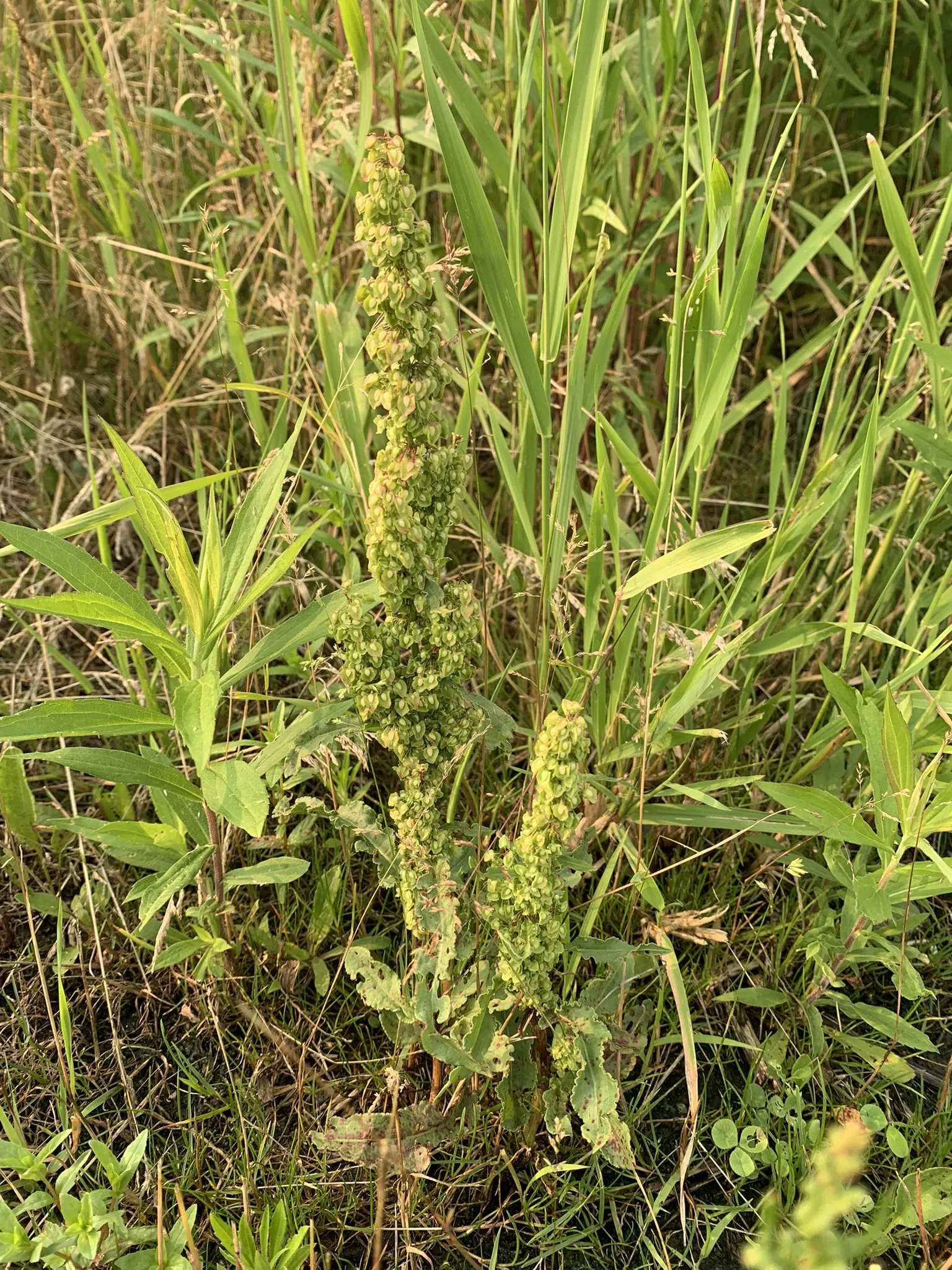
Dock
Family: Polygonaceae - Genus: Rumex - Species: R. crispus
Other names: Curly Dock, Yellow Dock
Quick facts
- Uses
- Edible
- Medicinal
- Edible parts
- leaf, seed
- Type
- perennial herb
- Flowers
- Apr–Aug
- Height
- 60–120 cm
- Native to
- Europe and Asia
- Habitat
- fields, roadsides, wet ground
| Month | Observations |
|---|---|
| January | 1 |
| February | 3 |
| March | 5 |
| April | 57 |
| May | 76 |
| June | 104 |
| July | 54 |
| August | 18 |
| September | 6 |
| October | 1 |
| November | 2 |
| December | 1 |
Curly dock is easiest to spot in late summer, when its tall seed stalks turn rusty red-brown and stand out across fields and ditches. They stay standing well into winter.
It's a tough perennial in the buckwheat family, with a deep taproot that lets it survive droughts, mowing and most attempts to get rid of it.
How to spot it
- Leaves are long and narrow, up to 30 cm, with very wavy, crinkled edges. That's the "curly" in the name.
- Stems are grooved and often reddish. A thin, papery sleeve wraps the stem where each leaf joins it.
- Flowers are small and green, in dense rings up tall, branching spikes.
- Seeds are wrapped in three papery, heart-shaped wings that turn from green to red-brown.
- The root is yellow inside, which is where the name "yellow dock" comes from.
What it's good for
Young spring leaves have a sharp, lemony taste. They're good cooked, but they're high in oxalic acid, so don't eat them in large amounts. The seeds can be ground into a dark flour if you have the patience.
Herbalists use the root as a bitter tonic and a gentle laxative. Many people grew up rubbing dock leaves on nettle stings, and it's still a handy trick on a walk.
The root also makes a yellow dye.
Don't confuse it with
Broad-leaved dock has wider leaves with a heart-shaped base and flatter edges. You can use it the same way.
Gallery
Seed stalks among tall grass Plant with green seed clusters near water Mature plant with many seed spikes in a field Tall seed spike at a field edge Seed spikes at a field edge Seed heads turning red-brown in late summer
Where it grows
Each hexagon shows how many times Dock has been recorded there, from herbarium specimens, surveys and iNaturalist photos. Gaps can mean nobody has looked, not that the plant is absent.