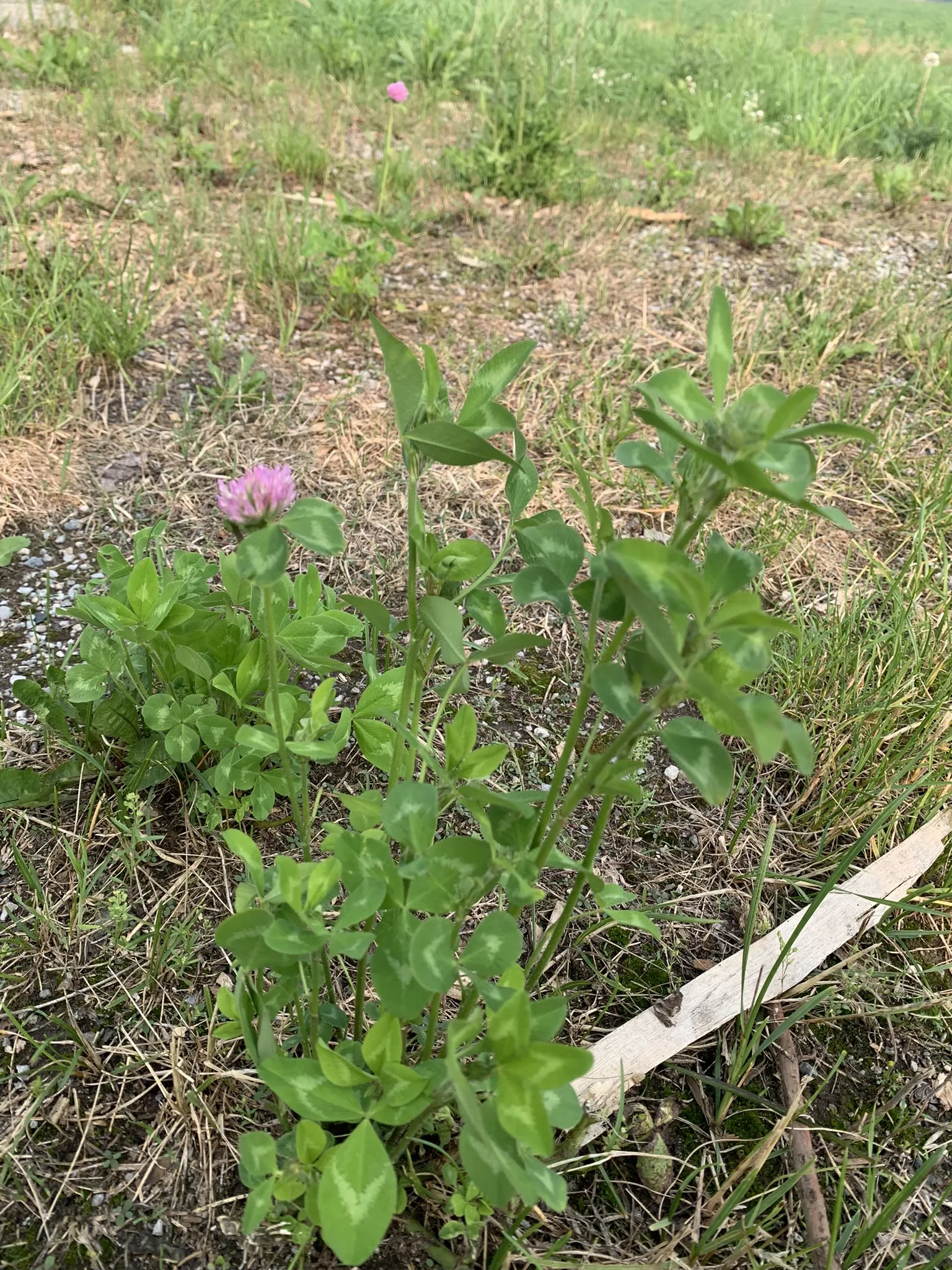
Clover
Family: Fabaceae - Genus: Trifolium - Species: T. repens
Quick facts
- Uses
- Edible
- Tea
- Wildlife
- Soil builder
- Edible parts
- leaf, flower
- Type
- perennial herb
- Flowers
- Feb–Oct
- Height
- 5–30 cm
- Native to
- Europe and Asia
- Habitat
- lawns, meadows, roadsides
| Month | Observations |
|---|---|
| January | 180 |
| February | 414 |
| March | 1240 |
| April | 3058 |
| May | 2634 |
| June | 2726 |
| July | 1662 |
| August | 876 |
| September | 992 |
| October | 520 |
| November | 268 |
| December | 85 |
White clover is in almost every lawn, and that's a good thing. It stays green in dry weather, feeds the grass around it, and is one of the best plants for bees in an ordinary yard.
It creeps along the ground on stems that root as they go, so a single plant can slowly turn into a patch.
How to spot it
- Leaves have three round leaflets, often with a pale "V" across each one. Four-leaf clovers are a rare mutation, so finding one really is lucky.
- Flowers are round white heads made of many small flowers, sometimes blushed with pink. Older flowers droop and turn brown.
- Stalks for the leaves and flower heads rise separately from the creeping stem.
What it's good for
The flowers and young leaves are edible in small amounts, raw or cooked. Dried flowers make a gentle, faintly sweet tea.
Clover's real job is feeding things. Bacteria in its roots fix nitrogen and feed the soil, which is why farmers sow it in pastures. Honeybees work the flowers all summer.
Its bigger cousin
Red clover is larger and grows upright, with pinkish-purple flower heads. Some of the photos above show it. You can use its flowers the same way, and they are a popular herbal tea.
Gallery
Clover in a mixed patch beside a path Pink flower head and three-part leaves White flower heads among the leaves Dense patch of white clover in bloom
Where it grows
Each hexagon shows how many times Clover has been recorded there, from herbarium specimens, surveys and iNaturalist photos. Gaps can mean nobody has looked, not that the plant is absent.