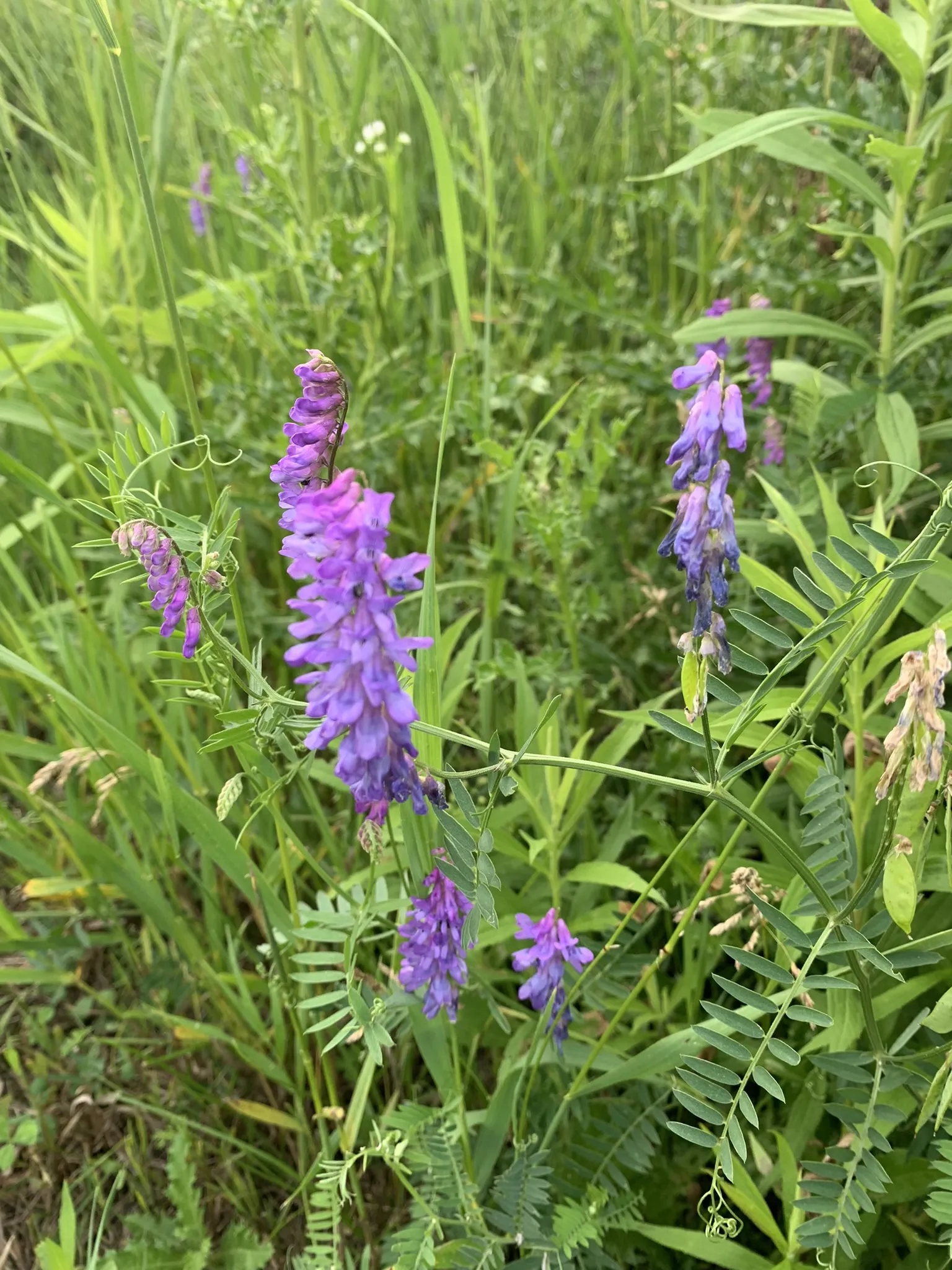
Bird Vetch
Family: Fabaceae - Genus: Vicia - Species: V. cracca
Other names: Tufted Vetch, Cow Vetch, Blue Vetch, Boreal Vetch
Quick facts
- Uses
- Wildlife
- Soil builder
- Edible parts
- None
- Type
- perennial vine
- Flowers
- Jun–Sep
- Height
- 60–120 cm (climbing)
- Native to
- Europe and Asia
- Habitat
- fields, roadsides, thickets
| Month | Observations |
|---|---|
| January | 1 |
| February | 0 |
| March | 0 |
| April | 1 |
| May | 67 |
| June | 1496 |
| July | 1181 |
| August | 443 |
| September | 222 |
| October | 89 |
| November | 75 |
| December | 2 |
In early summer, bird vetch turns field edges and roadsides purple. It's a climbing member of the pea family, and it scrambles over grass and shrubs using little tendrils at the ends of its leaves.
It came over from Europe and Asia. In some places it's welcome for feeding bees and enriching the soil. In others it smothers everything around it.
How to spot it
- Leaves are made of 8 to 12 pairs of narrow leaflets, and each leaf ends in a curling tendril.
- Flowers are violet-blue and pea-shaped, all lined up along one side of a long stalk like a comb.
- Pods are flat and turn brown when the seeds are ripe.
- Height is 60–120 cm when it has something to climb, or it sprawls in a tangle when it doesn't.
What it's good for
Bees and butterflies love it. Like other legumes, it carries bacteria in its roots that pull nitrogen from the air and feed it into the soil.
It isn't a plant for the kitchen. Some vetch seeds contain toxic compounds, and there's no tradition of eating this one.
Gallery
One-sided clusters of violet, pea-like flowers Pinnate leaves with curling tendrils Bird vetch spreading over a field edge
Where it grows
Each hexagon shows how many times Bird Vetch has been recorded there, from herbarium specimens, surveys and iNaturalist photos. Gaps can mean nobody has looked, not that the plant is absent.