Ground Ivy
Family: Lamiaceae - Genus: Glechoma - Species: G. hederacea
Other names: creeping charlie, gill-over-the-ground, alehoof, tunhoof, catsfoot, field balm
Quick facts
- Uses
- Medicinal
- Tea
- Edible parts
- leaf, flower
- Type
- perennial herb
- Flowers
- Mar–Jun
- Height
- 5–30 cm
- Native to
- Europe and Asia
- Habitat
- lawns, shady areas, woodland edges
| Month | Observations |
|---|---|
| January | 8 |
| February | 83 |
| March | 1378 |
| April | 4172 |
| May | 3410 |
| June | 872 |
| July | 18 |
| August | 5 |
| September | 2 |
| October | 4 |
| November | 3 |
| December | 3 |
If your lawn has a creeping carpet of round, scalloped leaves that smells like mint when you mow it, you've met ground ivy. Gardeners call it creeping Charlie and mostly want it gone. It spreads by runners that root at every joint, so pulling it out is a slow job.
Before hops took over, brewers used it to flavour and clear their ale. That's where the old name "alehoof" comes from.
How to spot it
- Leaves are round to kidney-shaped, with soft, rounded teeth, and grow in pairs.
- Stems are square, like every member of the mint family, and creep along the ground.
- The smell is the giveaway: crush a leaf and you get a strong, slightly bitter mint scent.
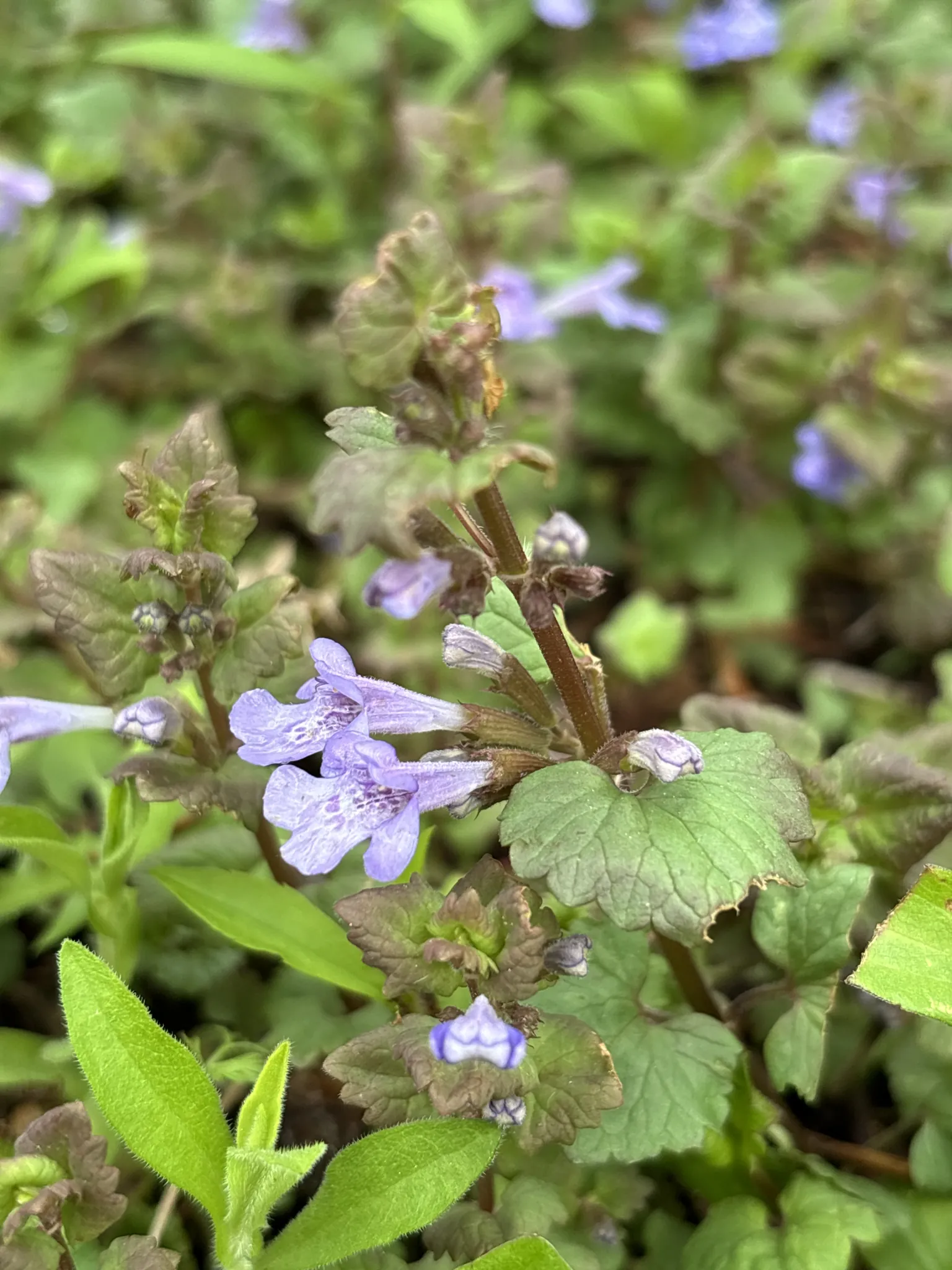
- Flowers are small, blue-violet funnels tucked in the leaf joints in spring.
What it's good for
The leaves are edible but strong, so a little goes a long way. Add a few to soups or salads, or steep them for a herbal tea.
Herbalists have long used ground ivy tea for coughs, colds and stuffy sinuses, and they put crushed leaves on small cuts. Not much modern research backs this up, but it has a long history of use.
Don't confuse it with
Henbit and purple dead-nettle grow in the same spots and also have square stems and purple flowers. They grow upright instead of creeping, and they don't have that minty smell.
Gallery
Blue-violet flowers in the leaf joints in spring Dense mat of rounded, scalloped leaves Kidney-shaped leaves with scalloped edges Ground ivy covering the ground
Where it grows
Each hexagon shows how many times Ground Ivy has been recorded there, from herbarium specimens, surveys and iNaturalist photos. Gaps can mean nobody has looked, not that the plant is absent.