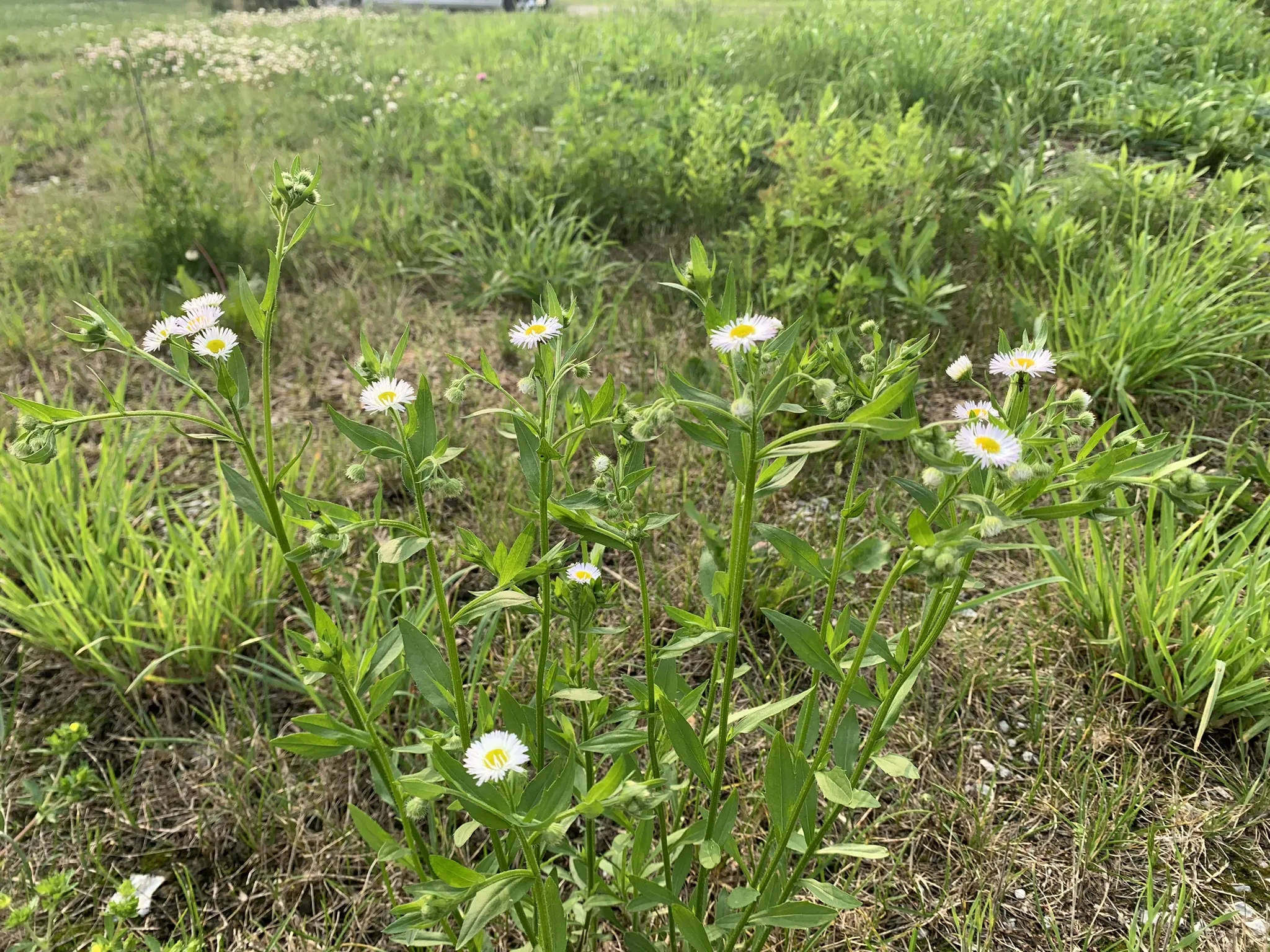
Fleabane
Family: Asteraceae - Genus: Erigeron - Species: E. annuus
Other names: Annual Fleabane, Daisy Fleabane, Eastern Daisy Fleabane
Quick facts
- Uses
- Medicinal
- Wildlife
- Edible parts
- None
- Type
- annual herb
- Flowers
- May–Oct
- Height
- 30–90 cm
- Native to
- North America
- Habitat
- fields, meadows, roadsides
| Month | Observations |
|---|---|
| January | 4 |
| February | 0 |
| March | 2 |
| April | 24 |
| May | 277 |
| June | 1097 |
| July | 634 |
| August | 223 |
| September | 143 |
| October | 156 |
| November | 42 |
| December | 9 |
Annual fleabane is a native North American wildflower that fills fields and roadsides with tiny white daisies from late spring until autumn. Each flower is only about the size of a fingernail, but a single plant can carry dozens of them.
The name comes from an old belief that bunches of the dried plant would drive fleas out of a house.
How to spot it
- Flowers are small daisies with 40 or more very thin white rays, sometimes tinged pink, around a yellow centre.
- Leaves on the stem are lance-shaped and toothed. The lower leaves are wider and have long stalks.
- Stems are hairy and branch near the top, growing 30–90 cm tall.
What it's good for
Mostly for the insects. Small bees, hoverflies and butterflies visit it all summer. Some Indigenous peoples used it to treat skin problems and as a diuretic, but there's little research on those uses.
Don't confuse it with
- Philadelphia fleabane flowers earlier, in spring. It has even more, finer rays, and its leaves wrap around the stem.
- Oxeye daisy has much bigger flowers, 3–5 cm across, with fewer, wider white rays.
Gallery
Patch of fleabane in bloom White, daisy-like flowers with yellow centres Branched flowering stems Close-up of a single flower Flowers among tall grass
Where it grows
Each hexagon shows how many times Fleabane has been recorded there, from herbarium specimens, surveys and iNaturalist photos. Gaps can mean nobody has looked, not that the plant is absent.