Wild Carrot
Family: Apiaceae - Genus: Daucus - Species: D. carota
Other names: Bird’s Nest, Bishop’s Lace, Queen Anne’s Lace
Quick facts
- Uses
- Edible
- Edible parts
- root, seed
- Type
- biennial herb
- Flowers
- Jun–Oct
- Height
- 30–120 cm
- Native to
- Europe and south-west Asia
- Habitat
- fields, roadsides, meadows
| Month | Observations |
|---|---|
| January | 16 |
| February | 9 |
| March | 29 |
| April | 161 |
| May | 378 |
| June | 1109 |
| July | 4454 |
| August | 3044 |
| September | 1346 |
| October | 572 |
| November | 240 |
| December | 35 |
Wild carrot, or Queen Anne's lace, is the wild ancestor of the carrots in your garden. In summer it fills fields and roadsides with flat, lacy white flower heads. Look in the centre of the head and there's often a single dark purple flower, said to be a drop of blood where Queen Anne pricked her finger while making lace.
It's a lovely plant, but it belongs to a family with some of the deadliest plants in North America. Learn it carefully.
How to spot it
Check every one of these before you pick:
- The stem is hairy. This is the most important feature. An old saying helps you remember: "Queen Anne has hairy legs."
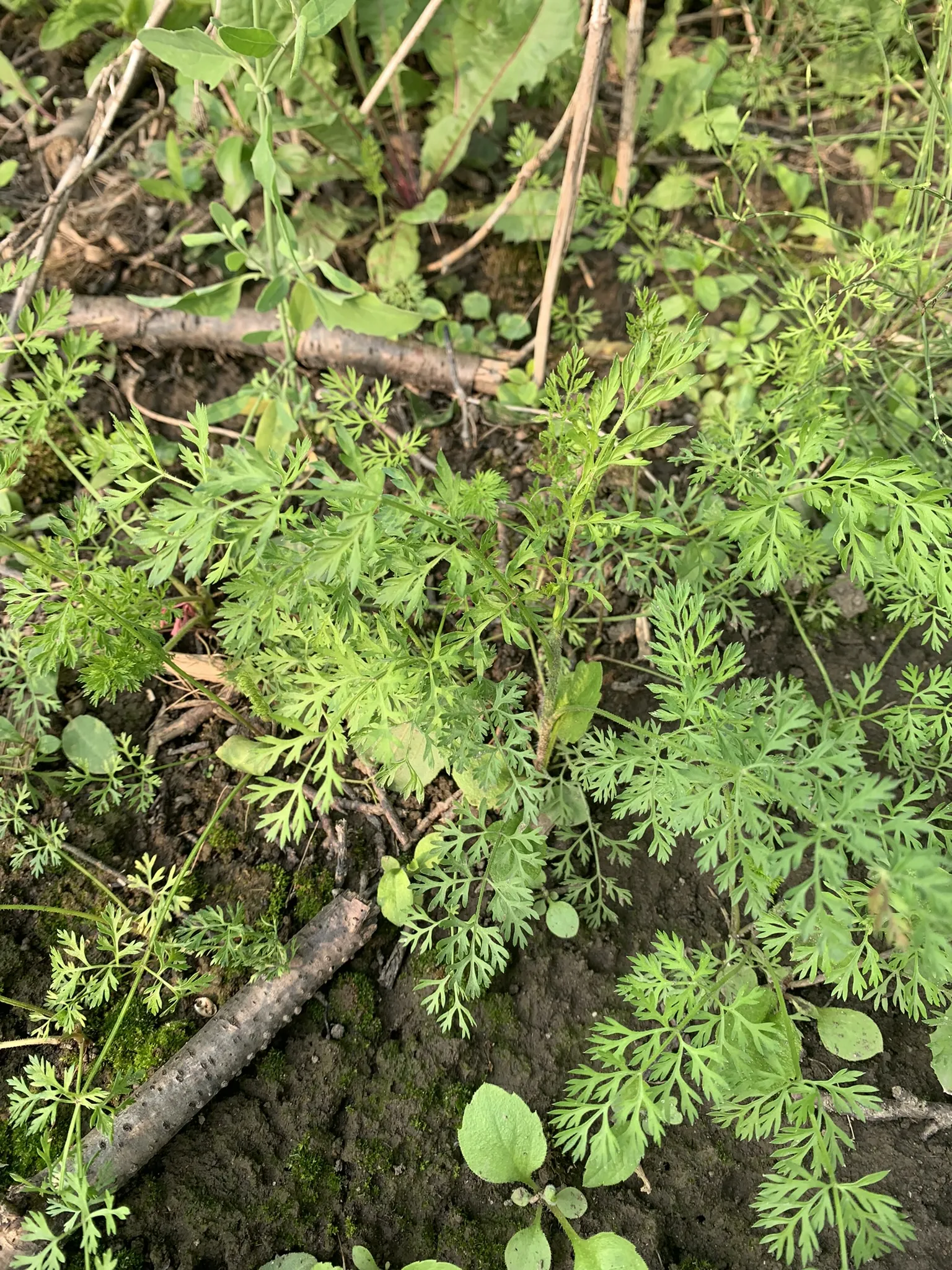
- Leaves are finely cut and feathery, just like carrot tops, and hairy underneath.
- Flowers form a flat, lacy umbrella of tiny white flowers, often with one purple flower in the middle. Long, forked green bracts stick out underneath.
- Seed heads curl up into a cup as they ripen, like a bird's nest.
- The smell of the crushed root and leaves is unmistakably carrot.
What it's good for
Dig the root of a first-year plant in autumn or early spring. It's thin, pale and woody, but it smells and tastes like carrot. You can batter and fry the flower heads, and many beneficial insects visit them.
Deadly lookalikes
- Poison hemlock has a smooth, hairless stem with purple blotches and a musty, mousy smell. It can grow over 2 m tall. Every part of it is deadly.
- Water hemlock has a smooth stem and grows in wet ground. It's one of the most toxic plants in North America.
If you aren't completely sure, leave it alone.
Gallery
Feathery, finely divided leaves Young plants on bare soil
Where it grows
Each hexagon shows how many times Wild Carrot has been recorded there, from herbarium specimens, surveys and iNaturalist photos. Gaps can mean nobody has looked, not that the plant is absent.